|
 What is PIC? What is PIC?
The PIC is a
small computer.
The PIC
16x8x Family.
What Dose the
F,C,CR & LF in the
PIC
device number mean.
Special
Features of the PIC 16f84
Design of the PIC16x8x.
Memory Arrangement.
Special Function Registers
(FSR)
 Flash Animated
Tutorials Flash Animated
Tutorials
Simplified animated tutorials for the PIC microcontroller
(English Only!)

Free
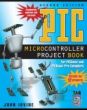
PIC Books
 Creme de la Creme of PIC Books absolutely
Free!.
Creme de la Creme of PIC Books absolutely
Free!.
Added
25/11/2007
|
|
|
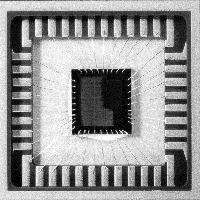 Basically,
a microcontroller is a device which integrates a number of the components of
a microprocessor system onto a single microchip. Basically,
a microcontroller is a device which integrates a number of the components of
a microprocessor system onto a single microchip.
So a microcontroller combines onto the same microchip:
The CPU core
Memory (both ROM and RAM)
Some parallel digital I/O
More...
|
|
 Almost all electronics
components either generate, store, control or switch electricity in someway.
A circuit is made of various components that act together to produce a
desired effect. There is a lot to learn about electronics and you may never
truly understand everything about the subject. Almost all electronics
components either generate, store, control or switch electricity in someway.
A circuit is made of various components that act together to produce a
desired effect. There is a lot to learn about electronics and you may never
truly understand everything about the subject.
More...
|
|
|
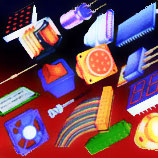
Electronic Components
-
Resistors
-
Capacitors
-
Inductors
-
Vacuum Tubes
-
Diodes
-
Transistor
|